

How merchants get connected
01
Tell us about your business — sector, markets, volumes

02
We introduce you to an authorised distributor for your market
03
They handle onboarding and technical integration

Two products, one merchant network
One integration and one compliance stack, reaching two customer segments that no single payment method covers on its own.
SpendLayer Direct
Your customer pays with the 16-digit authorisation code tied to their SpendLayer wallet. Entering it at checkout creates a mandate between them and you, with a defined amount, frequency and limit. Settlement is on-chain.
Recurring, natively
Subscriptions and instalments collect without the customer re-authorising each time — the capability no other alternative payment method in this space offers.

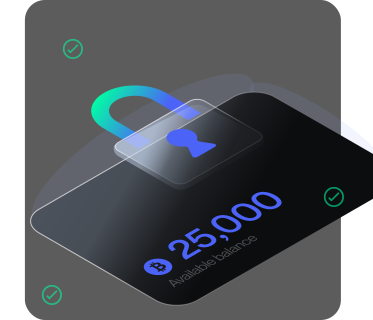


No chargebacks
Settlement is final. There is no card-network dispute path, and no reserve held against one.
Auditable end to end
Every authorisation and collection is a public on-chain event, verifiable without access to our systems.

How
Direct
works at checkout
The authorisation code is a payment reference, not a credential. It exposes no keys and grants no access to your customer's funds — it identifies the wallet that a mandate is created against.

Customer enters their 16-digit code at your checkout
A mandate is created — amount, frequency, duration, ceiling
Collection runs on schedule without re-authorisation
Settlement is on-chain and final — no chargeback path



Monthly
Subscription
-12.50 USDC

Recurring
Top-up
-9.99 USDC

Instalment
Plan
-29.00 USDC

Why on-chain matters to you
An issuer whose flows can be audited is one whose acquirer relationships hold

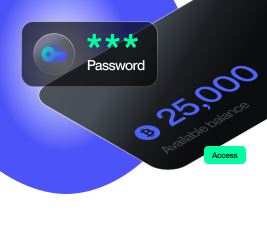
Independently auditable
Acquirers and partners can verify flows on-chain, not by asking us for a report.

Compliance in code
Limits and restrictions are encoded and deterministic, not back-office policy.
Final settlement
No dispute path, no reserve requirement, no clawback months later.

Customers cards miss
Reaches wallet-native customers you cannot serve through a card checkout.
Two calls, and you are live
Create a payment request from your server, send the customer to the hosted checkout we return, and settle the order when the completion webhook arrives. Authentication is an API key plus an HMAC-SHA256 signature over the request body.
Frequently asked questions
Still have questions?
Tell us about your business and we will point you to the right distributor for your market.
No. Merchants cannot integrate the SpendLayer APM independently. To accept SpendLayer, you partner with one of our authorised distributors or integrators, who handle the technical integration and onboarding.
Tell us about your business and we will introduce you to the partners covering your market, so you can find the right fit.
Every SpendLayer wallet is linked to a unique 16-digit authorisation code. It is the wallet's payment identity, and it is what lets SpendLayer Direct function as an alternative payment method at checkout.
Your customer enters the code at checkout, which creates a payment mandate between them and you, defining the agreed amount, frequency and limits. The code is not an access credential: it exposes no private keys and grants nobody access to funds.
Collection stops from that point. Revocation is unilateral and takes effect on-chain, so you will not be able to collect further instalments under that mandate, and there is no retry path.
In practice this behaves like a cancelled direct debit: you keep everything already collected, and you handle the cancellation in your own billing logic. Every revocation is an on-chain event, so it is visible to your systems immediately rather than surfacing later as a failed charge.
SpendLayer Direct suits you if a meaningful share of your customers already hold crypto and can pay from their own wallet. It is available now, and it is the only option of the two that supports recurring collection.
SpendLayer Voucher is intended for customers who hold no crypto at all. It is still in development, so if that segment matters to you, talk to us and we will tell you where it stands rather than guess at a date.
The full merchant integration reference is published at spendlayerapm.com/docs — endpoints, request signing, the status lifecycle and webhook payloads, with worked Node.js examples.
It covers the wallet-code checkout flow. Recurring collection under a mandate is handled separately, so raise it with your integration contact if you need it. Commercial terms are set by the distributor you work with.
Availability varies by product and jurisdiction, and sanctioned jurisdictions are excluded throughout. Tell us where you operate and we will confirm what is available to you.
